Business analysis
The step every business model canvas skips
Most founders finish the canvas and go straight to building. The step in between — the one that would have told them which assumption was about to sink them — almost never happens.
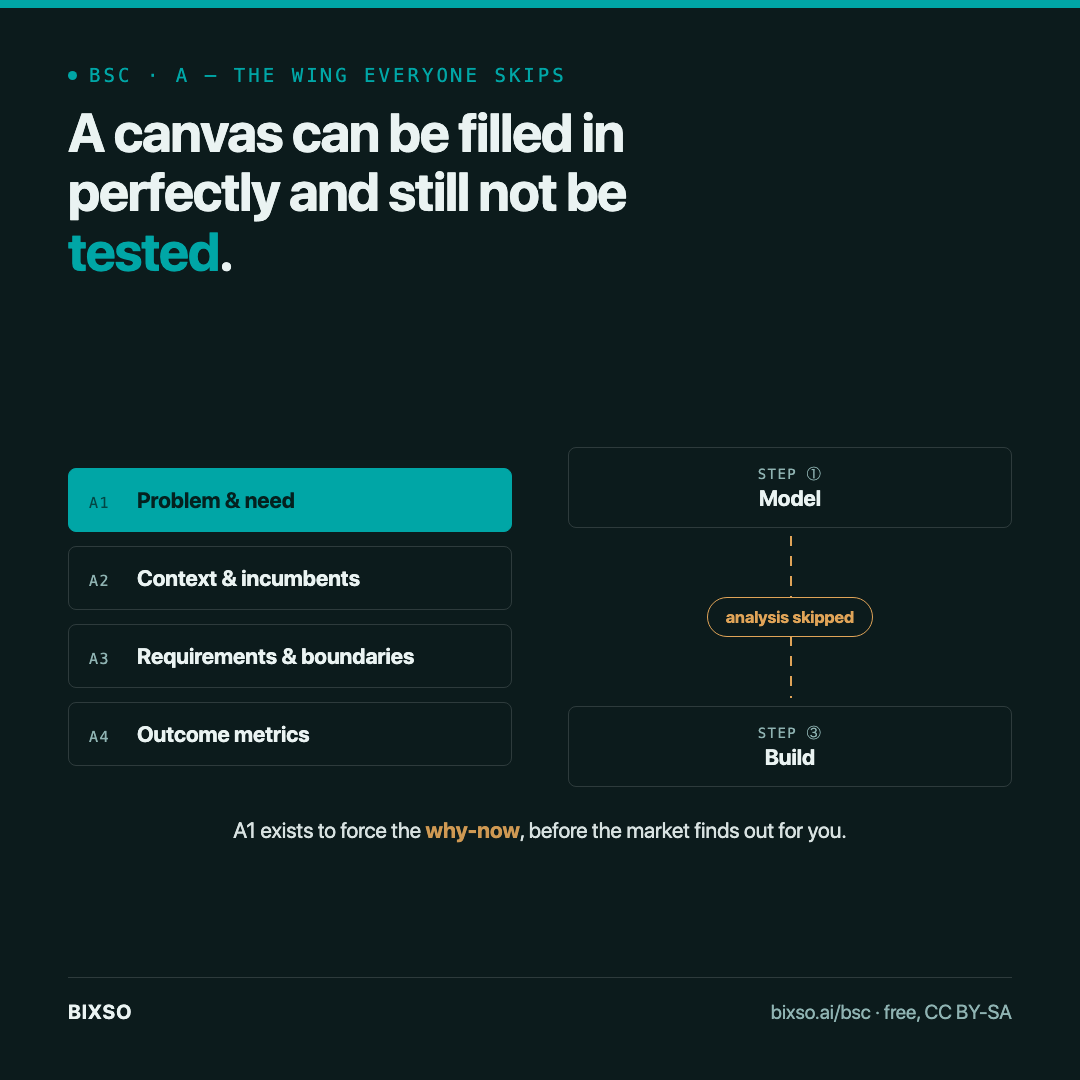
A completed canvas feels like a decision. Nine boxes filled, a tidy story about customers and value and revenue — and then the team moves straight to building. Business model researcher Daniel Pereira, in his guide to testing business models, names the trap in one line: producing a reasonable model at the start of a venture “does not mean it will stay sound forever.” A canvas is a set of assumptions dressed up to look like facts.
Seven steps, and everyone stops at step one
Pereira lays out a testing cycle that runs seven steps: concept the model, separate what’s fact from what’s assumption, build hypotheses specific enough to be proven wrong, choose a test format, set up and run the test, then feed the results back into the model. Step one — describing the business — is the part every founder does well, usually on a Business Model Canvas or something like it. Step two, identifying which of those nine boxes is a guess rather than a fact, is the part almost nobody reaches before they start building.
That’s not a discipline problem. It’s a structural one. A canvas is built to describe a business, not to interrogate it. The “customer segments” box doesn’t ask you to prove anyone in that segment actually has the pain you’re assuming. Nothing in a nine-box grid forces the question of why this problem, why now, rather than a year ago or a year from now.
What the missing box is actually for
This is exactly the gap the Analysis wing of the Business Solution Canvas exists to close. Its first cell — A1, Problem & need — isn’t a restatement of the value proposition. It asks for the root pain, not the symptom that was noticed first, and it asks for evidence of why-now: what changed that makes this worth solving today. Business analysis has a name for the same idea — the need concept in BABOK’s core model — but the practical test is the same one Pereira’s hypothesis-building method uses: is this a fact you can point to, or a belief the team fell in love with before questioning it?
Skipping A1 doesn’t mean a founder has no analysis. It means the analysis happens later, live, in production, at customer expense — a much more expensive place to discover that the “obvious” problem wasn’t the real one.
The shortcut that looks fastest and rarely is
Under time pressure, the instinct is to go straight from a modeled idea to the build — especially now, when the build itself can be an AI feature shipped in an afternoon. That shortcut is real, and it’s exactly the one line teams draw without noticing: model, skip, agentic AI. It saves a week up front. It also means the first real test of the problem is the market, not a hypothesis you could have falsified for a fraction of the cost.
Run it before you build
Before the next feature or the next product gets built, write down the assumption sitting under it as a sentence you could prove false. Ask why this problem matters now and whether you have evidence for that, not a hunch. If the honest answer is “we assumed,” that’s the analysis step talking — do it before the build, not after the market does it for you.
The Business Solution Canvas is free and openly licensed (CC BY-SA), one A3 page, no sign-up — the Analysis wing exists so that step doesn’t get skipped again.
Sources: Daniel Pereira, “Business Model Testing” — Super Guide, The Business Model Analyst, Ottawa, 2022 (ISBN 978-1-7387612-9-6): the seven-step testing cycle and hypothesis-building method. IIBA, “A Guide to the Business Analysis Body of Knowledge” (BABOK Guide): the need concept within the Business Analysis Core Concept Model.