BSC · an open framework by BIXSO
The Business Solution Canvas.
A one-page framework for designing business solutions: Business Model × Business Analysis × Agentic AI, filled in a fixed order and closed by a pass/fail gate.
1 · Definition
What the BSC is — and where it comes from.
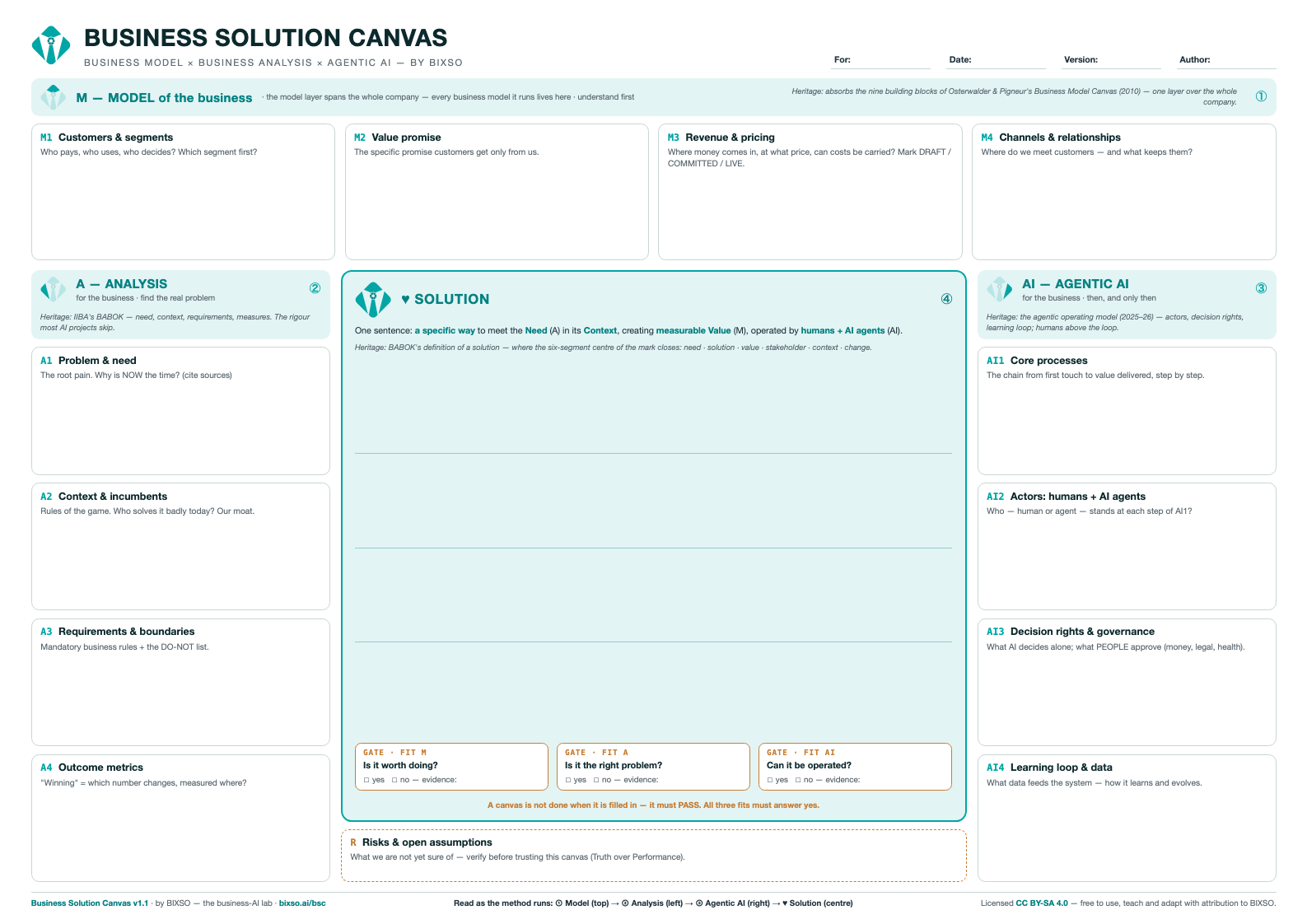
The Business Solution Canvas (BSC) is a one-page planning framework for designing a business solution — BABOK's term for "a specific way of satisfying a need in a context, creating value for stakeholders". It fuses three disciplines around that solution:
- Business Model — how the business creates and captures value. Absorbed from Osterwalder & Pigneur's Business Model Canvas (2010), whose nine blocks map into the BSC's Model wing.
- Business Analysis — the rigour: root problem, context, boundaries, measures. Grounded in the IIBA's BABOK and its six core concepts (need, solution, value, stakeholder, context, change), which map onto the canvas — the solution at its heart.
- Agentic AI — the operation: processes, human and AI actors, decision rights, learning loop. Grounded in the agentic operating models that emerged through 2025–26, where governance boundaries decide whether an AI system survives contact with reality.
The BSC does not replace those bodies of work — it stands on them. What it adds is composition: one page where the three disciplines must agree before anything gets built.
2 · Structure
One centre, three wings, one open risk.
Thirteen fields and a gate, laid out the way the method runs. The Model layer spans the full top row — one layer over the whole company, every business model it runs, carrying the Business Model Canvas heritage. Analysis descends the left (the BABOK rigour that finds the real problem); Agentic AI takes the right (the operating side); and the Solution sits at the heart, where the six-segment centre of the BIXSO mark closes. Top → left → right → centre: reading the canvas is running the method.
① M — Model of the business
Who pays, who uses, who decides — and which segment comes first.
The specific promise customers get only from this solution.
Where money comes in, at what price, whether costs can be carried. Entries are marked draft, committed or live.
Where the business meets its customers, and what keeps them.
② A — Analysis for the business
The root pain, and the evidence for why now is the time to solve it — with sources.
The rules of the game, who solves the problem badly today, and the durable advantage.
Mandatory business rules, plus an explicit do-not list.
What "winning" means as a number — which metric changes, measured where.
③ AI — Agentic AI for the business
The chain of work from first customer touch to value delivered, step by step.
Which human or AI agent stands at each step of AI1.
What AI may decide alone, and what people must approve — money, legal, health.
What data feeds the system, and how it learns and evolves.
3 · Method
The order is the philosophy.
The BSC is filled in a fixed order — and the order is a rule, not a suggestion:
- ① Model first. Understand the business — customers, value, money, channels — before touching anything technical. Business first, technology second.
- ② Analysis second. Find the real problem: root cause, context, boundaries, and what winning measures. This is the step most AI projects skip — and the reason most of them fail.
- ③ Agentic AI third. Only now design the operation: processes, who does what (human or agent), who holds each decision, how the system learns.
- ♥ Solution last. State the solution in one sentence and take it to the gate.
4 · The gate
Three questions. All three must answer yes.
The model says the value and the money are real.
The analysis says this is the root need, in this context, with these boundaries.
The operation is designed: actors, decision rights, learning loop — it can actually run.
This is the BSC's defining difference. A canvas that is merely complete proves nothing; a canvas that passes is a decision. If any fit answers no, the solution goes back a wing — that is the framework working, not failing. The three questions take ten minutes; they save months.
5 · Versioning & stewardship
A living framework, recorded properly.
The BSC is developed continuously by its author — a Master Business Analyst — and BIXSO, and refined with what we learn from running it on our own products and client work. Every change is versioned here; the canvas file carries its version number. Adaptations of the canvas are welcome under the licence — the canonical version lives on this page.
| Version | Date | Change |
|---|---|---|
| v1.1 | 20 Jul 2026 | Layout revision by the author: the Model wing now spans the full top row — one layer over the whole company (the Business Model Canvas heritage made visible); Analysis moves to the left wing, Agentic AI the right. Academic lineage notes added to each wing on the canvas itself. |
| v1.0 | 19 Jul 2026 | First public release: 1 centre + 3 wings × 4 fields + R, fixed fill order, three-fit gate. Published under CC BY-SA 4.0. |
6 · Licence & attribution
Open, by design — like the canvases before it.
The Business Solution Canvas is published under Creative Commons Attribution-ShareAlike 4.0 →. You may use, teach, adapt and build on it — including commercially — as long as you credit BIXSO and share adaptations under the same licence. BIXSO never sells the framework; we make our living applying it.
Suggested attribution: "Business Solution Canvas" by BIXSO (bixso.ai/bsc), licensed under CC BY-SA 4.0.
6b · From research to action
Use the BSC as a path, not a poster.
The framework converts best when the reader can move from public research into the method, then into a lesson, a practice space and a real consult.
Read source-backed observations and BIXSO lessons from shipped products.
02MethodRun the Business Solution Canvas in the fixed order: Model, Analysis, Agentic AI, gate.
03LessonLearn the method in guided modules before applying it to a real business problem.
04PracticeShare a canvas, get feedback, and compare decisions with the BIXSO community.
05ConsultBring the problem to BIXSO when the canvas needs founder-level judgement.
7 · Learn & practise
The canvas is the start. The ecosystem is the practice.
A free course on the BSC, with AI tutoring and human mentorship. Regular BSC courses are being built here.
About the academy → Practise & sharebixso.netFill a canvas for your own idea and share it with the #BSC community — help-first, trust measured by value.
About the network → ProofThe portfolioWe run every BIXSO product — and every client engagement — through the same canvas. The proof ships.
See the portfolio →If you'd like help running the BSC on your own business, the first consultation is free — talk to us →. No obligation; the canvas is yours either way.