Business model
The most profitable business models share one boring trait
Subscription, franchise, affiliate, freemium, drop-shipping — ten different names sold as ten different ideas. Underneath, they're the same mechanic wearing different clothes, and the mechanic is not exciting.
Business model researcher Daniel Pereira’s 2023 survey of the most profitable models reads like a tour of very different businesses: a streaming subscription, a razor-and-blade consumables play, a P2P marketplace taking a cut, a franchise collecting royalties. Ten names, ten industries, ten pitches that each sound like a distinct insight. His companion reference, the Business Models Almanac, catalogues over 200 more — All You Can Eat, Aggregator, Ad-Free Subscription, Accreditation — each with its own name and its own “how it works” page.
The trick is that there’s barely a trick
Read past the names and the mechanics collapse into a handful of moves. All You Can Eat is a fixed fee for unlimited use — which is a subscription with different marketing. An Aggregator makes money by selling ad space or taking an affiliate cut — which is the advertising model or the affiliate model, relabeled for a specific shape of website. Pereira’s own subscription and razor-and-blade write-ups make the same point from the profitable side: both work by locking in a recurring unit of exchange — a monthly charge, a consumable refill — so revenue doesn’t reset to zero and get re-earned from scratch with every customer, every time.
That’s the boring trait. None of the ten profitable models above are profitable because the underlying idea was clever. They’re profitable because someone specified, precisely, what repeats: one subscription cycle, one consumable cartridge, one ad impression sold, one percentage of one transaction. The almanac’s 200+ entries look like 200 ideas. They’re closer to a dozen repeatable units, dressed in different names for different industries.
Why “the right model” is a real question, not a formality
Pereira’s guide is direct about what’s actually at stake in the choice: the model “dictates the pricing strategy, payment mechanisms, and monetization avenues” — and a model built around a single non-recurring sale carries more risk than one that diversifies revenue and doesn’t depend on constantly finding a new buyer for a first-time sale. That’s not a branding decision. It’s a decision about whether the business has to re-sell itself from zero every day, or whether it’s built something that keeps charging for a unit it already delivered once.
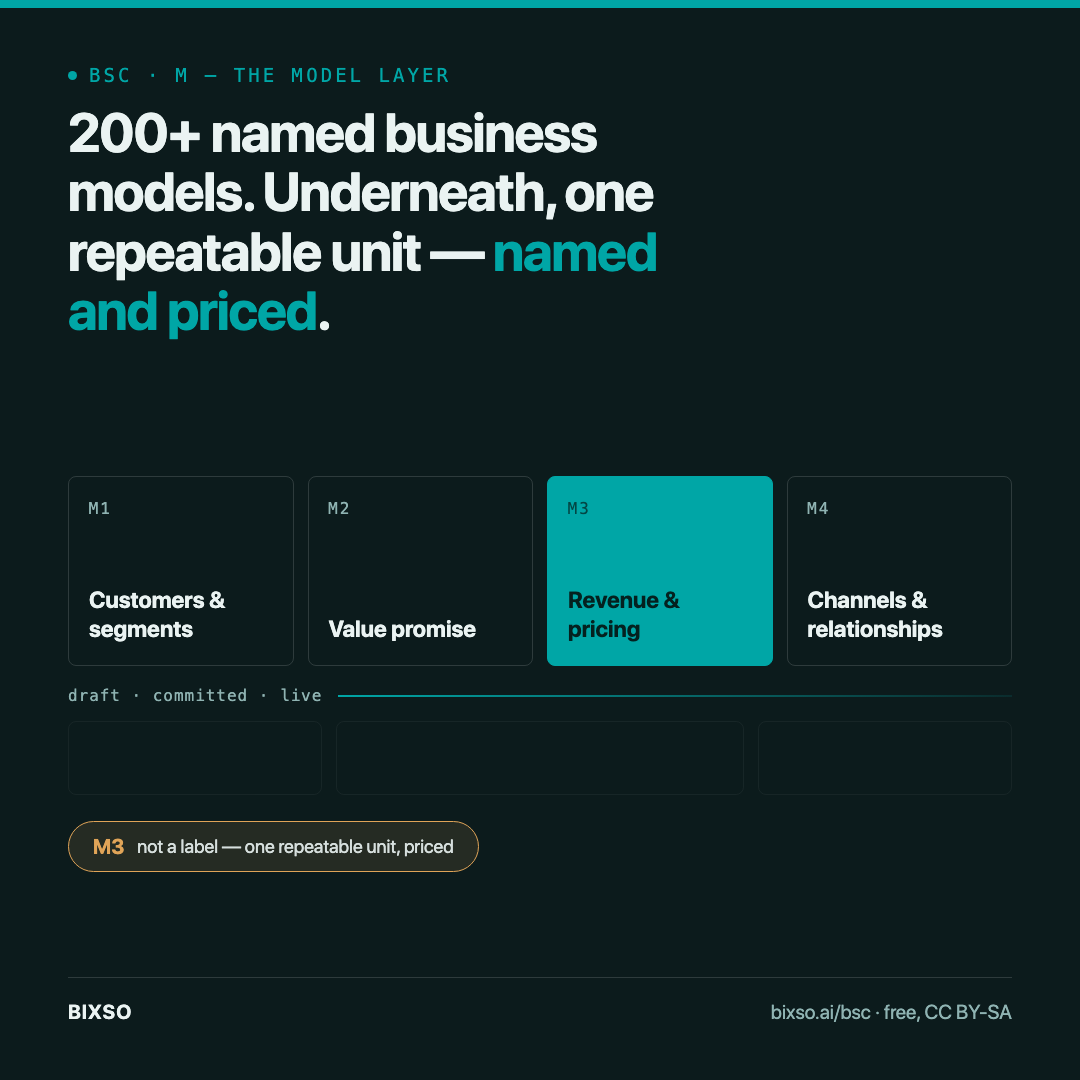
This is exactly what the M3 cell — Revenue & pricing — on the Business Solution Canvas is built to force. Most founders fill M3 with a category label: “subscription,” “marketplace,” “freemium.” That’s the Almanac trap in miniature — a name standing in for a mechanic nobody has actually specified. M3 isn’t satisfied by the label. It asks for the exact repeatable unit (what, exactly, recurs — and at what price) and a status: is this a draft guess, a committed agreement with a real customer, or live revenue collected today.
Run it before the next pitch deck
Before the next “we’re building a subscription business” sentence leaves the room, name the unit that actually repeats and tag it draft, committed, or live. If the honest tag is draft, the model isn’t proven — it’s a category borrowed from a book, same as picking “Aggregator” off a list of 200 names. The unglamorous discipline — one repeatable unit, one honest status — is what the ten profitable models above have in common, and it’s cheaper to write down on a canvas than to discover it’s missing after the business is built.
The Business Solution Canvas is free and openly licensed (CC BY-SA), one A3 page, no sign-up — M3 exists so “subscription” stops being a label and starts being a number you can defend.
Sources: Daniel Pereira, “10 Most Profitable Business Models in 2023” — Super Guide, The Business Model Analyst, Ottawa, 2022 (ISBN 978-1-998007-51-6): the revenue-generation and risk-diversification case for choosing a model deliberately, and the ten-model survey. Daniel Pereira, “Business Models Almanac: The Big Book of Business Types and Their Business Models,” The Business Model Analyst, Ottawa, 2022 (ISBN 978-1-998892-26-6): the 200+-entry catalogue, including the All You Can Eat and Aggregator model entries referenced above.