Agentic AI
Decision rights: the box that decides whether your AI project survives
Most AI projects don't break on the model. They break the first time an agent does something reasonable that nobody was willing to put their name against.
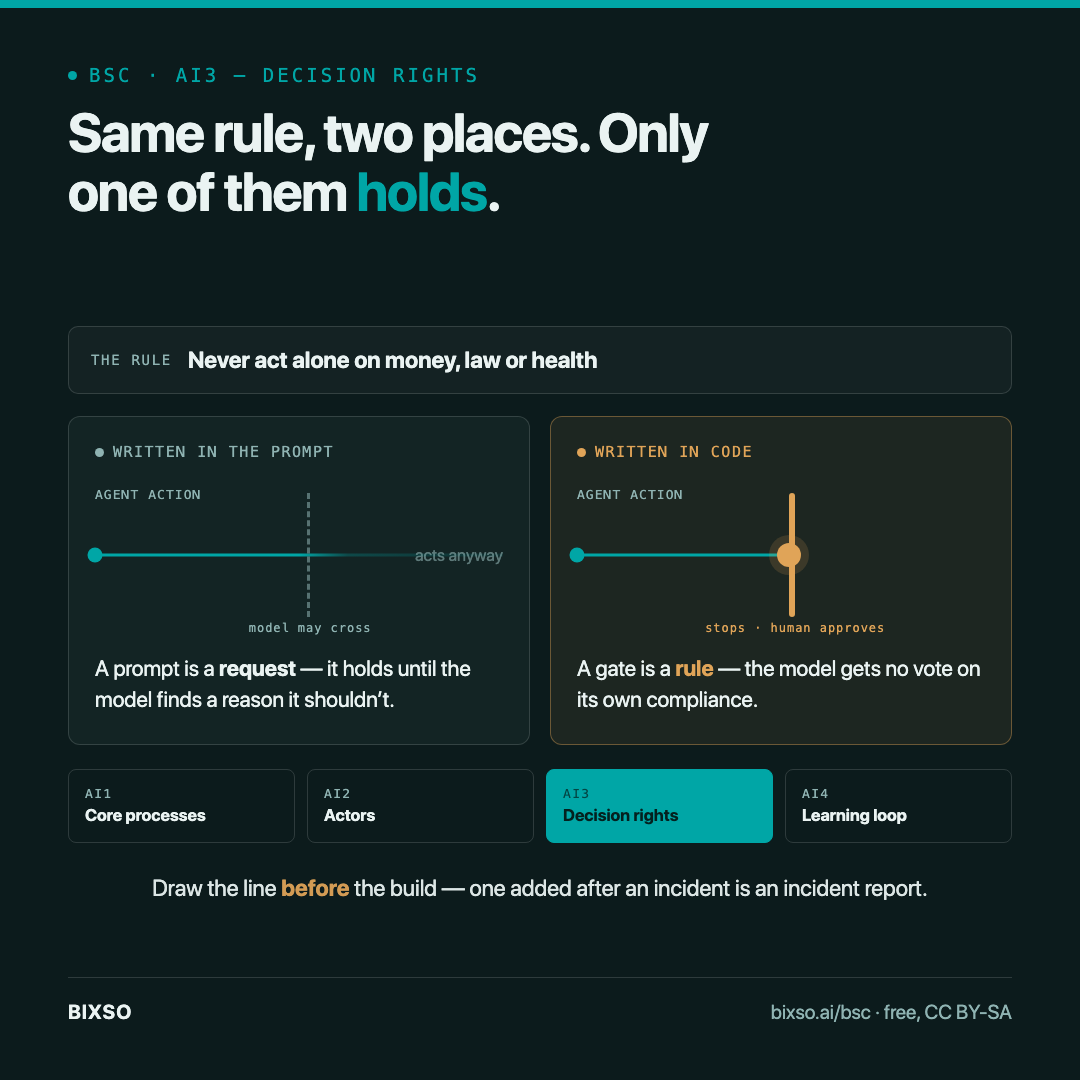
The demo works. The answers are good. Then someone asks the only question that has ever stopped a rollout: when this thing is wrong at 2am, who signed off on it acting alone? If that answer has to be invented in the moment, the project has already failed — it just hasn’t been told yet.
Governance is usually audited, not designed
Business analyst Daniel Pereira, writing on digital transformation readiness, puts governance in the assessment column: before transforming anything, an organisation should check whether it actually has structures that let decisions get made, accountability land somewhere, and risk get managed. That’s the right instinct, and it’s how most companies still treat the question — as something you evaluate about the organisation, once, at the top.
Agentic systems break that framing. An agent doesn’t consult the org chart; it acts, per request, thousands of times, in places no committee is watching. So the boundary can’t only exist as an organisational property. It has to exist as a property of the running system — decided per decision, before the build, and enforced at the moment of action.
Where this lives on the canvas
Cell AI3 (Decision rights) on the Business Solution Canvas exists to force that answer while it’s still cheap. Not “is the AI accurate?” but: which decisions may the agent make alone, which require a human signature, and what happens to the request in between. Fill it before the build and it’s a design constraint. Fill it after an incident and it isn’t a canvas cell — it’s an incident report.
The honest test of whether AI3 is really filled is uncomfortable, and it’s this: is the boundary in the code, or only in the prompt? A prompt is a request to a model. Code is a rule the model cannot talk its way past. Those are not the same guarantee, and the difference only shows up on the day it matters.
What that looks like when it’s real
BIXSO runs this on its own products, and the pattern is always the same — move the line out of the prompt and into something deterministic:
- Health (Y Võ Việt Nam). The rule that AI never diagnoses, prescribes, or promises a cure used to live in the agent’s prompt — meaning the model was trusted to police itself. It now lives in a code gate that inspects the model’s output and replaces it with a safe response if it drifts, then routes the person to a real licensed practitioner. Code decides; the model doesn’t get a vote on its own compliance.
- Marketing (Serviceplace). An in-app agent can draft a campaign piece. When it finishes, the system writes the quality gates back to fail — every time. The agent is not permitted to grade its own work. And a paid campaign can only reach
pending_approval; there is no code path by which an agent spends money. - Escrow (bixsourcing). Releasing funds above a threshold requires two different human approvals — the same admin cannot approve twice. The entire subsystem also ships switched off until the legal review closes, because “built and tested” and “allowed to touch real money” are two separate permissions.
None of that makes the AI weaker. It makes it deployable.
Run it on your own system this week
Take one agent you already have. List every decision it touches. Beside each one write either agent alone or human approves — and put anything involving money, law, health, or anything irreversible in the second column, with no “for now” exceptions. Then check where each of those lines is actually written. If it’s in a prompt, it’s a preference. Move it into a gate, a state machine, or an approval step, and it becomes a boundary.
The Business Solution Canvas is free and openly licensed (CC BY-SA), one A3 page, no sign-up — AI3 is there so this line gets drawn on a quiet afternoon instead of during an incident.
Source: Daniel Pereira, “Digital Transformation Strategies” — Super Guide, The Business Model Analyst, Ottawa, 2022 (ISBN 978-1-998007-23-3): governance assessed as the structures enabling decision-making, accountability and risk management. Product examples are BIXSO’s own implementations.