Business model
Your cost model is a decision, not an accounting line
Cost structure sits at the bottom of most business model canvases, filled in last, treated as the accountant's problem. Research on cost modeling treats it as load-bearing — wired straight into resources, partners and activities. Skip the wiring and the "decision" gets made by default, not on purpose.
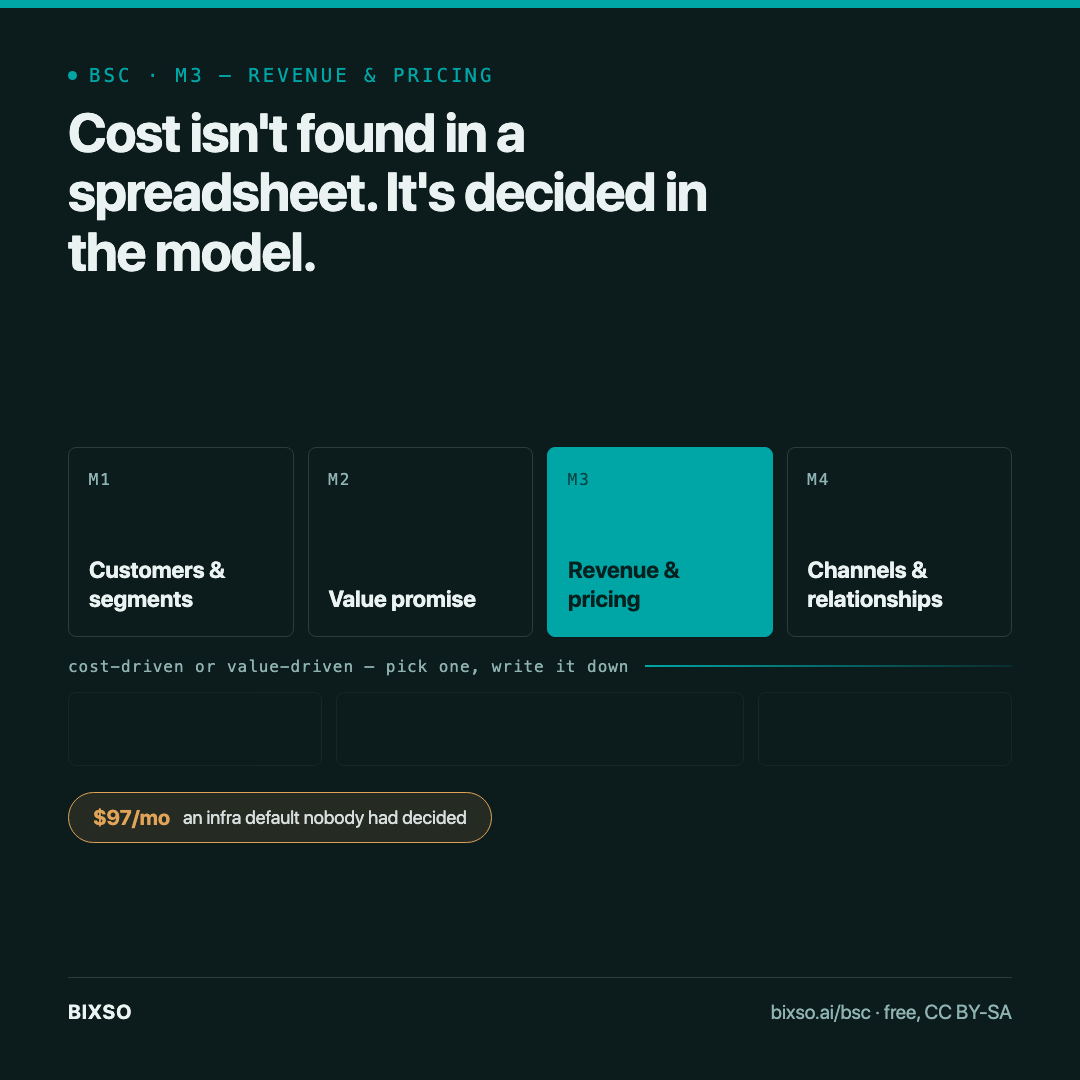
Daniel Pereira’s guide to cost models makes a point that’s easy to skim past: cost structure isn’t its own island on the canvas. It’s tied directly to Key Resources, Key Partnerships and Key Activities — the three blocks that actually generate most of a company’s costs — and it can’t be filled in honestly until those three are analysed first. Treated that way, cost structure stops being the accounting afterthought at the bottom of the page and becomes a summary of choices made everywhere else on the model.
Cost-driven and value-driven aren’t judgments — they’re architectures
The guide splits businesses into two broad postures. Cost-driven businesses treat resource allocation as a constant push to minimise expense — through specialisation, outsourcing, automation, low-price positioning — and compete on efficiency. Value-driven businesses centre on the customer experience, run leaner on price discipline, and recover margin through premium pricing and retention instead. Neither is better; they’re simply different bets about where a company’s attention goes. What the framework insists on is that this is a decision, made deliberately, not a personality a business discovers by accident when a competitor undercuts it or a customer complains about price.
Pereira’s companion guide on cost reduction adds the sharper edge for anyone running a software business today: independent research he cites puts a minimum of 33% of activities as automatable in roughly 60% of jobs — and treats Robotic Process Automation as one of the concrete levers, capable of eliminating rule-based, repetitive transactional work with reported ROI gains north of 100% in year one. That’s not a footnote about efficiency. It’s a claim that automation changes which cost-driven or value-driven identity is actually available to a business — a cost structure that was fixed labour becomes a cost structure that’s variable compute, and the two behave completely differently under scale.
Where this shows up on the Business Solution Canvas — and inside BIXSO
The M3 cell — Revenue & pricing on the Business Solution Canvas is explicitly written to carry this question alongside price: not just “what do we charge,” but “can the cost structure behind that price actually be sustained.” BIXSO’s own Energy economy is the concrete answer to that question rather than a slogan: every AI call is priced at energy_at_cost × markup, a real number tied to Vertex/Gateway usage — not an estimate, not a category label like “we run on the cloud.”
The clearest internal proof of what happens when that discipline is skipped came from BIXSO’s own infrastructure, not a hypothetical. An audit of Cloud Run configuration across the product fleet found one backend running min-instances=2 — two always-on server instances kept warm for an app receiving roughly six requests a day. Nobody had decided that cost structure. It was a leftover default from an earlier deploy, quietly costing about US$97 a month for capacity nothing was using. Scaling it to zero (serving the same six requests a day, on demand) closed the gap immediately, with the fleet re-audited to confirm the fix held. That’s cost structure exposed as a decision that was never actually made — the exact failure mode the framework warns about, just running on a server instead of a spreadsheet.
Run this before the next budget line gets approved
Pick one: is this cost centre supposed to be cost-driven (minimise, automate, compete on price) or value-driven (spend to protect the experience, recover through retention)? If you can’t answer in one sentence, it hasn’t been decided yet — it’s drifting. Then trace your largest recurring cost line back to the resource, partner, or activity decision that created it, not the vendor invoice that bills for it. And check your own infrastructure defaults the way this audit did: a config nobody revisited since launch is the tell that a cost is running on autopilot, not on a decision — cheaper to catch on a canvas than to discover on a bill.
The Business Solution Canvas is free and openly licensed (CC BY-SA), one page, no sign-up — M3 exists so “cost structure” stops being the line filled in last and becomes the one checked first.
Sources: Daniel Pereira, “Cost Models” — Super Guide, The Business Model Analyst, Ottawa, 2022 (ISBN 978-1-998892-24-2): cost structure’s dependency on Key Resources/Partnerships/Activities, and the cost-driven vs value-driven classification. Daniel Pereira, “Cost Reducing Strategies and Techniques,” The Business Model Analyst, Ottawa, 2022 (ISBN 978-1-998892-36-5): the automation/RPA cost-reduction data cited above. Osterwalder & Pigneur, Business Model Generation, 2010.