Business models
When did your business model last pass an inspection?
Most companies check their cars more often than their business models. A practical way to run the check-up — three questions, ten minutes, borrowed from assessment methodology and built into an open canvas.
We book the car in for a service once a year, even when nothing rattles. We see the dentist even when nothing hurts. Business model researcher Daniel Pereira opens his assessment guide with exactly that comparison — and then lands the uncomfortable question: when did your business model last get the same treatment?
For most companies the honest answer is: at founding, once, on a whiteboard. The model got described — often on a Business Model Canvas — and then everyone went to work. But as Pereira puts it, creating a reasonable business model at the beginning of a venture does not mean it will stay sound forever. The business world is full of companies that started from a great idea and failed along the way, quietly, while their canvas gathered dust.
The three tests a strong model must pass
Assessment methodology gives us a compact answer to what “sound” means. A strong business model, per Pereira’s Business Model Assessment (2022), has to survive three tests:
- Desirability — do customers actually want this? Test the assumptions about the customer’s pain and the solution built for it.
- Viability — does the money work? Can you earn more than the solution costs to run?
- Feasibility — can you actually build and operate it, with the technology, resources and partners you really have?
Three tests, three different failure modes. A desirable product that loses money on every sale. A profitable idea aimed at a problem nobody has. A brilliant model that the team can’t actually operate. Any one of them, unchecked, is enough.
From periodic check-up to a standing gate
Here is the shift we’d suggest: don’t treat those three tests as an annual health check. Treat them as a gate — something a solution must pass before it gets built, and again every time the model changes.
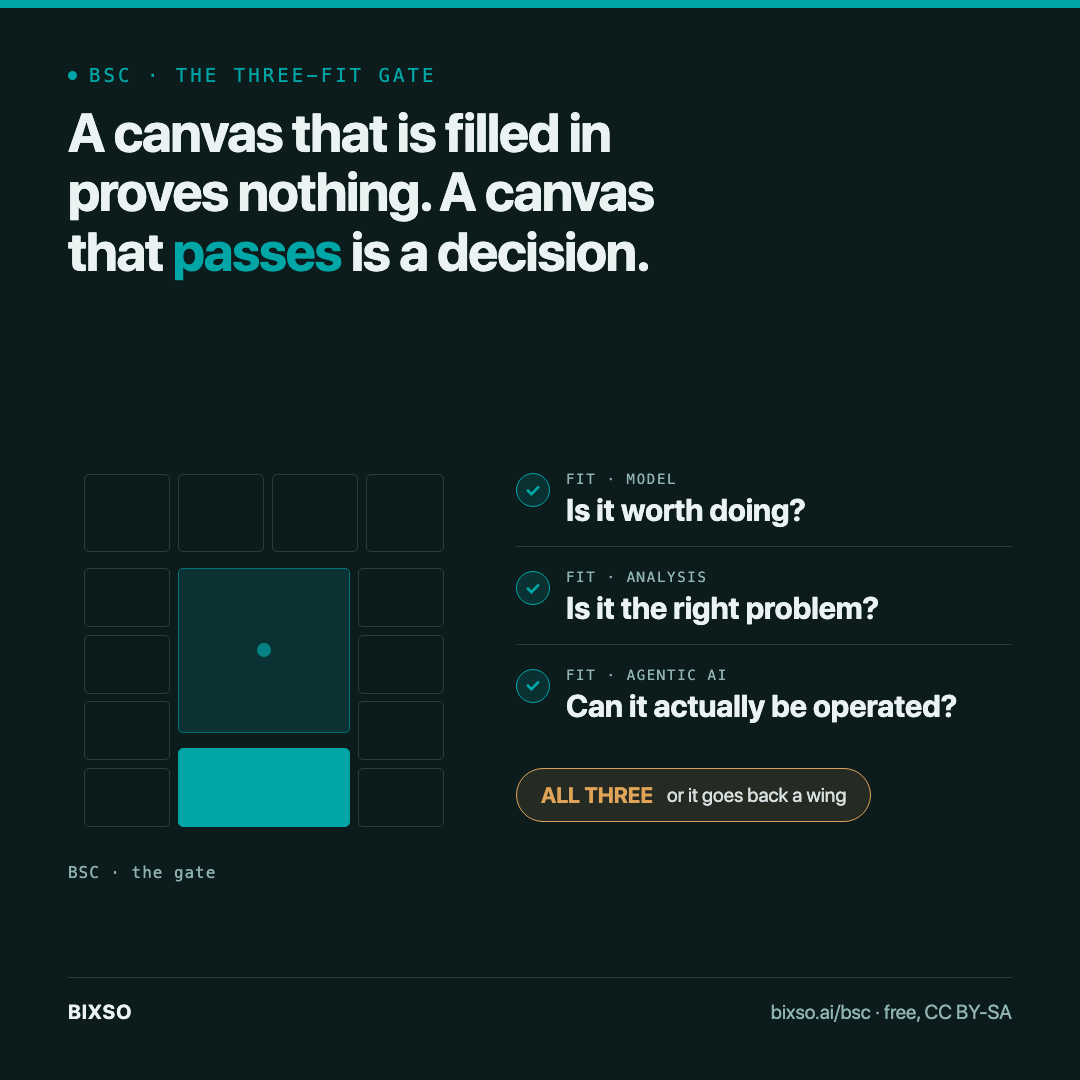
That is exactly how we built the Business Solution Canvas, our open one-page framework. Its top row maps the business model (the Osterwalder heritage — one layer over the whole company). Its left wing forces the analysis most projects skip. Its right wing designs the operation, humans and AI agents together. And at the centre sit three gate questions that will look familiar:
- Is it worth doing? — viability, asked of the Model wing.
- Is it the right problem? — desirability, asked of the Analysis wing.
- Can it be operated? — feasibility, asked of the operating wing.
A canvas that is merely filled in proves nothing. A canvas that passes is a decision. If one question answers no, the solution goes back a wing — that’s the framework working, not failing.
We run this on our own products before we write a line of code, and it has killed ideas we liked. That is the point.
Run the check-up today
You don’t need a workshop or a consultant to start. Take your current business model — the real one, as it runs today — and ask the three questions honestly. Write the evidence next to each answer, not just the yes or no. The whole pass takes about ten minutes, and it tends to surface the one assumption everyone has been politely not mentioning.
If you want the full canvas around those questions, it’s free: the Business Solution Canvas is openly licensed (CC BY-SA), one A3 page, no sign-up. Print it, run your model through it, and see whether it passes.
Sources: Daniel Pereira, “Business Model Assessment” — Super Guide, The Business Model Analyst, Ottawa, 2022 (ISBN 978-1-998892-03-7): the check-up framing and the desirability · viability · feasibility criteria. Alexander Osterwalder & Yves Pigneur, “Business Model Generation” (2010): the nine-block Business Model Canvas the BSC’s Model wing absorbs.