Agentic AI
AI business models: the ones that survive charge for outcomes, not tokens
A subscription number looks like a business decision. Usually it is a guess, made before anyone knows what the product will actually cost to run — and the guess breaks the moment real usage arrives.
Most AI products get priced the way most software has always been priced: pick a number, wrap it in a tier name, ship it. The team that picked the number usually did it before the AI feature had run against a single real user — so the price is a guess about a cost nobody has measured yet.
Three ways to charge, one structural difference
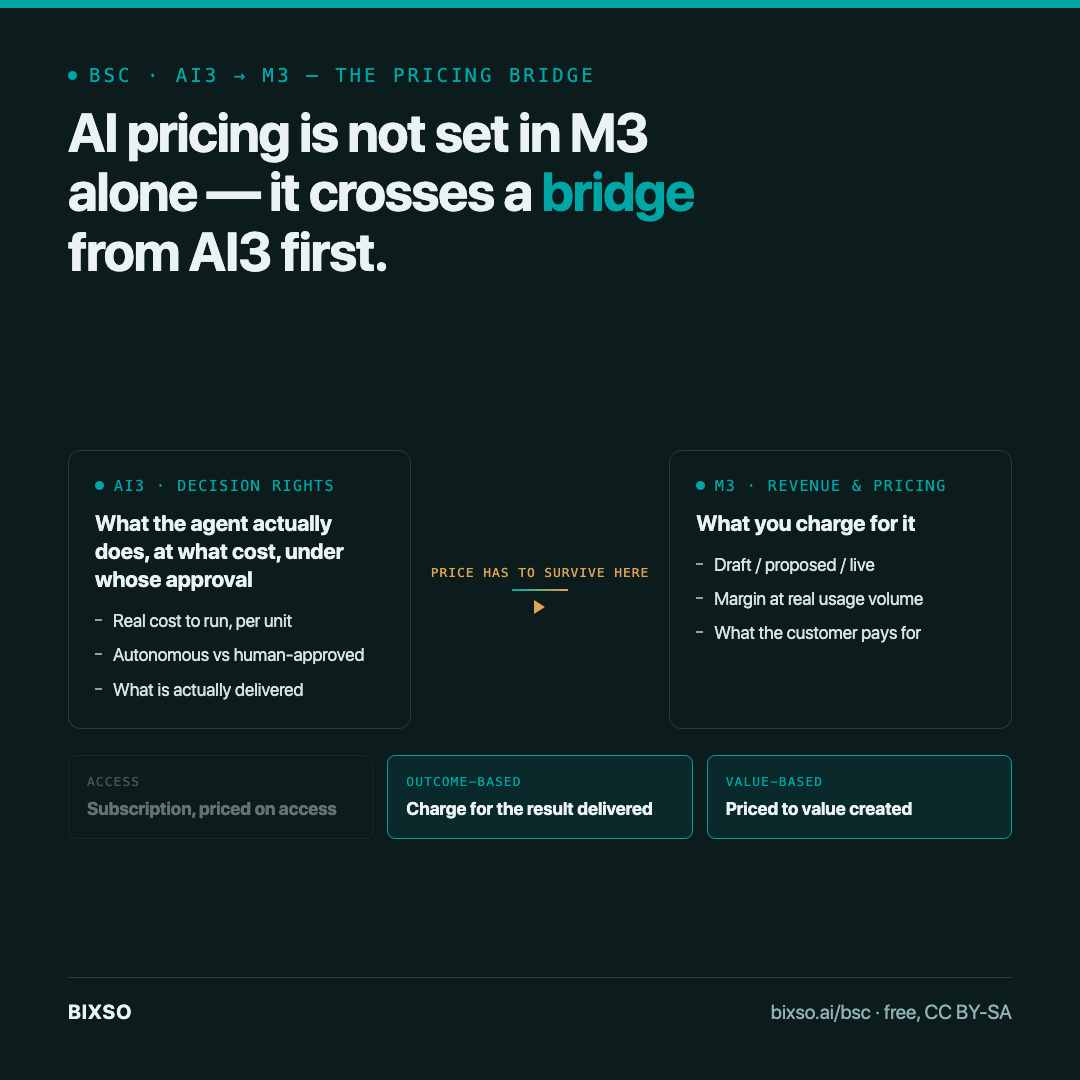
Business model researcher Daniel Pereira, cataloguing how companies actually monetise AI, lists three approaches organisations reach for. Licensing and subscription — sell access to the capability, recurring, usually flat or lightly tiered. Outcome-based pricing — charge for the result the AI actually produced, so the price only lands when the value does. Value-based pricing — set the number against what the solution is worth to the customer, not what it cost to build.
The difference between these isn’t cosmetic. A subscription prices access to a capability whose real running cost is variable and, for a genuinely agentic feature, was never fully known when the price was set. Outcome-based and value-based pricing both price something that only exists after the AI has actually done work — which forces the number to stay connected to what the thing is worth, rather than drift away from it as usage scales.
The bridge nobody draws
This is the gap the Business Solution Canvas makes explicit by forcing a connection most pricing decisions never make. Its AI wing has a cell — AI3, decision rights & governance — that isn’t about pricing at all on the surface: it defines what the agent is actually allowed to do on its own, what a human has to approve, and by extension what the thing genuinely costs to run per unit of use. The Model wing’s M3, revenue & pricing, is where that number gets charged. Most pricing decisions treat these as two separate rooms. The canvas draws the bridge between them on purpose: a price set in M3 that never crossed back through AI3 is a number that was never checked against what the AI is really doing or what it really costs.
BIXSO’s own Energy economy is the plainest example we can point to without hand-waving. Every metered AI action returns its real wholesale cost from the gateway before anything is charged — energy_at_cost, the cost converted straight into the same unit the customer spends. What the customer actually pays is that number multiplied by one explicit, tunable dial (a markup constant), not a separately-guessed subscription figure sitting in a different spreadsheet. The free tier — 200⚡ a month, worth roughly $4 at face value — was sized against what that free usage would really cost to serve, not against what felt generous. It is metered pricing, not outcome-based pricing in Pereira’s strict sense — but it is metered pricing that keeps the AI3-to-M3 bridge alive on every single call, which is the property that actually matters.
Where the bridge collapses
The bridge collapses quietly. A team ships a flat “$X/month, unlimited AI” tier before knowing what “unlimited” costs at real volume — power users show up, the cost line moves, and the margin the subscription was supposed to protect is gone before finance notices. Or a team builds outcome-based pricing on top of an AI3 that was never actually defined — nobody agreed what counts as “the outcome,” so billing and product argue about it after launch instead of before. Either failure has the same root: the price was decided without a working answer to what the AI is actually doing and what that costs.
Check the bridge before you ship the price
Before a pricing tier goes live, write down what AI3 actually says for that feature: what the agent does autonomously, what a human has to sign off on, and the real cost per unit of that work — not an estimate from a slide, a number from an actual test run. Then check the M3 price against it: does it survive the cost at 10x volume, not just at the demo? If the honest answer is “we haven’t run that number,” the AI3-to-M3 bridge hasn’t been built yet — and the price sitting in the roadmap is still a guess wearing a subscription name.
The Business Solution Canvas is free and openly licensed (CC BY-SA), one A3 page, no sign-up — the AI wing exists so a pricing decision never gets made without first crossing back through what the AI is actually doing.
Sources: Daniel Pereira, “AI Business Models” — Super Guide, The Business Model Analyst, Ottawa, 2022 (ISBN 978-1-998007-17-2): the licensing/subscription, outcome-based and value-based pricing approaches for monetising AI, and the AI-as-a-Service subscription/pay-per-use model.