Business analysis
370,500 Australian businesses stopped trading last year
The number is real and it comes from the ABS. It also does not measure what almost everyone who quotes it assumes it measures — and the definition sits one click away, in the methodology page nobody opens.
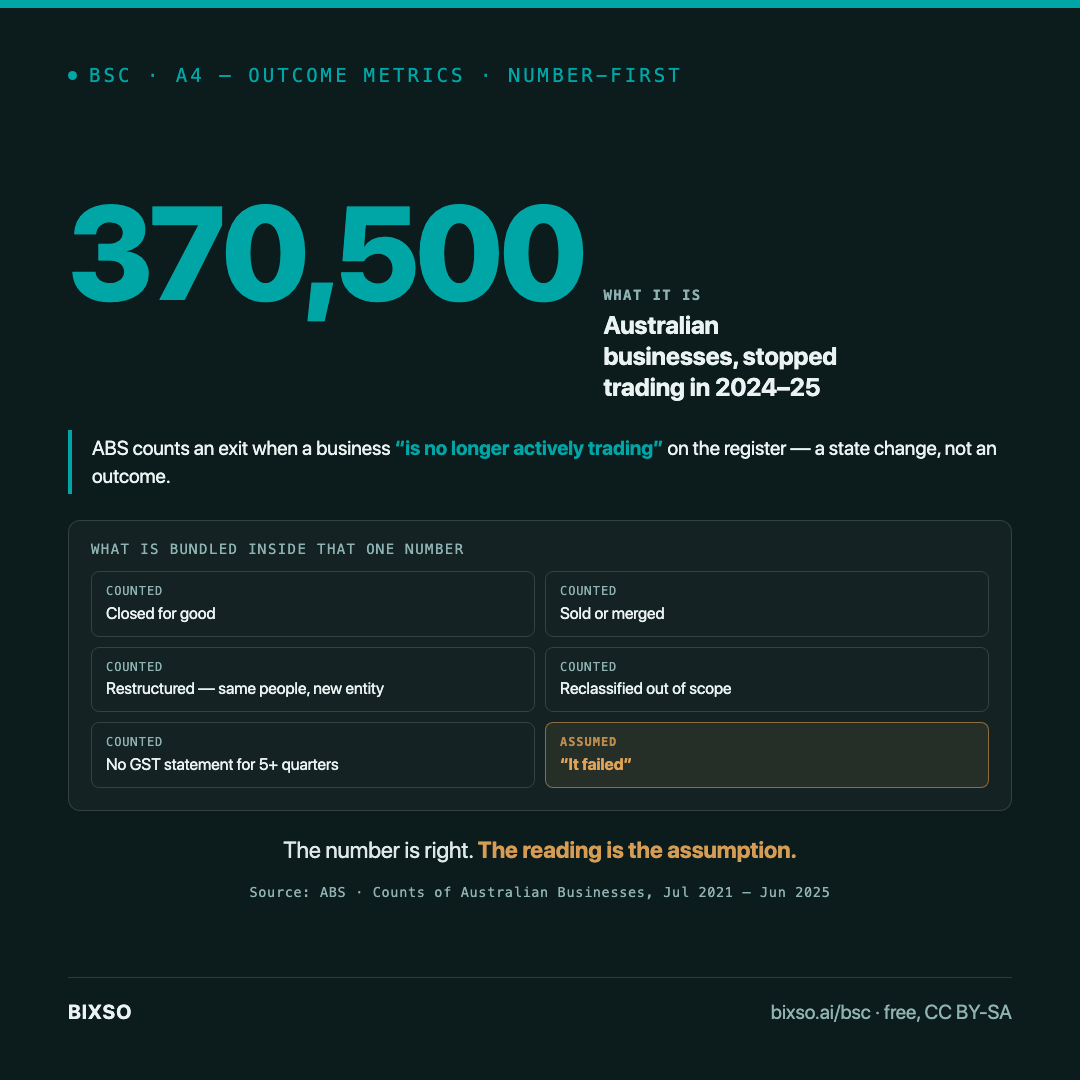
370,500.
That is how many Australian businesses stopped actively trading in 2024–25, according to the Australian Bureau of Statistics. Over the same period 437,150 new businesses started. At 30 June 2025 there were 2,729,648 actively trading businesses in the economy.
Divide the first two and you get a sentence that writes itself: for every 100 businesses that opened, roughly 85 closed. It is accurate arithmetic. It is also the point where most analysis stops and most conclusions go wrong.
What the number actually counts
The ABS definition of an exit is one sentence:
“A business exit is counted when an actively trading business on the ABSBR at 30 June in the previous year is no longer actively trading at 30 June in the reference year.”
Read it slowly. It counts a state change on a register, not an outcome. A business is counted as an exit when it cancels its ABN — which happens when it closes, and also when it is sold, restructured, merged, or ceases Australian operations. It is counted when it becomes a long-term non-remitter, meaning five or more quarters without lodging a GST statement. It is counted when an industry reclassification moves it out of scope.
The ABS is explicit that the publication does not separate businesses that failed from businesses that exited for any other reason. The number is not hiding this. It simply isn’t the number people think they are quoting.
The evidence sits in the same dataset
You don’t have to go outside the release to see the gap. The same publication reports that in 2024–25, non-employing businesses grew by 4.3% (71,633), including a net movement of 32,428 surviving businesses from employing to non-employing.
Those 32,428 are described by the ABS with one specific word: surviving. A company that let its last employee go and kept trading as a sole operator did not fail. Depending on how the register recorded it, it may still show up in a movement statistic that a careless read files under “businesses lost”.
Why this is an analysis problem, not a statistics problem
Nothing above is a criticism of the ABS. The methodology is published, the definition is plain, and the caveat is stated. The failure happens downstream, in the step where someone turns a measured quantity into a claim about the world.
That step has a repeatable test, and it is three questions long:
- What event does this number count? Not what does it represent — what physical or administrative event increments it by one.
- What is bundled inside it? Every aggregate hides categories. Name them before you use the total.
- What would have to be true for my conclusion to follow? Here: that a register state-change equals a business failure. Written out, it’s obviously too strong.
Any number that survives those three questions is usable. Most don’t, and the ones that don’t are usually the most quotable.
On the canvas
In the Business Solution Canvas this lands in two places.
A4 — outcome metrics. A metric is not a name, it’s a name plus a definition. “Businesses that stopped trading” and “businesses that failed” differ by an assumption large enough to change what you build.
A1 — problem and need. If a product’s founding premise is “85% of new businesses fail”, the premise is not grounded — it’s an artefact of a number that was never measuring failure. Building for a problem you have not defined precisely enough to count is the most expensive mistake in the analysis wing, and it is invisible until much later.
The honest version, since this cuts both ways: BIXSO’s own north star is people who use the canvas. We have not defined “use” tightly — downloaded it, opened it, filled one wing, passed the gate? Those are four different numbers and we currently report the loosest one available to us. Writing this made that harder to keep ignoring.
One thing to take away: before a number becomes a reason, open the methodology and find out what single event makes it go up by one.
Sources: ABS, Counts of Australian Businesses, including Entries and Exits, July 2021 – June 2025 — latest release and methodology.
BSC is BIXSO’s open framework for working through business model, analysis and agentic AI as one loop — bixso.ai/bsc.